References
[1] Berzaghi, F., Longo, M., Ciais, P. et al. Carbon stocks in central African forests enhanced by elephant disturbance. Nat. Geosci. 12, 725–729 (2019). https://doi.org/10.1038/s41561-019-0395-6
[2] Poulsen, John & Beirne, Christopher & Rundel, Colin & Baldino, Melissa & Kim, Seokmin & Knorr, Julia & Minich, Taylor & Jin, Lingrong & Núñez, Chase & Xiao, Shuyun & Mbamy, Walter & Obiang, Guichard & Masseloux, Juliana & Nkoghe, Tanguy & Obiang Ebanéga, Médard & Clark, Connie & Fay, Michael & Morkel, Pete & Okouyi, Joseph & Wright, Justin. (2021). Long Distance Seed Dispersal by Forest Elephants. Frontiers in Ecology and Evolution. 9. 10.3389/fevo.2021.789264.
[3] Schmitz, Oswald & Sylvén, Magnus & Atwood, Trisha & Bakker, Elisabeth & Berzaghi, Fabio & Brodie, Jedediah & Cromsigt, Joris & Davies, Andrew & Leroux, Shawn & Schepers, Frans & Smith, Felisa & Stark, Sari & Svenning, Jens-Christian & Tilker, Andrew & Ylänne, Henni. (2023). Trophic rewilding can expand natural climate solutions. Nature Climate Change. 13. 10.1038/s41558-023-01631-6.
[4] Berzaghi, F., Longo, M., Ciais, P., Blake, S., Bretagnolle, F., Vieira, S., Scaranello, M., Scarascia-Mugnozza, G., & Doughty, C. E. (2019). Carbon stocks in central African forests enhanced by elephant disturbance. Nature Geoscience, 12(9), 725-729. https://doi.org/10.1038/s41561-019-0395-6
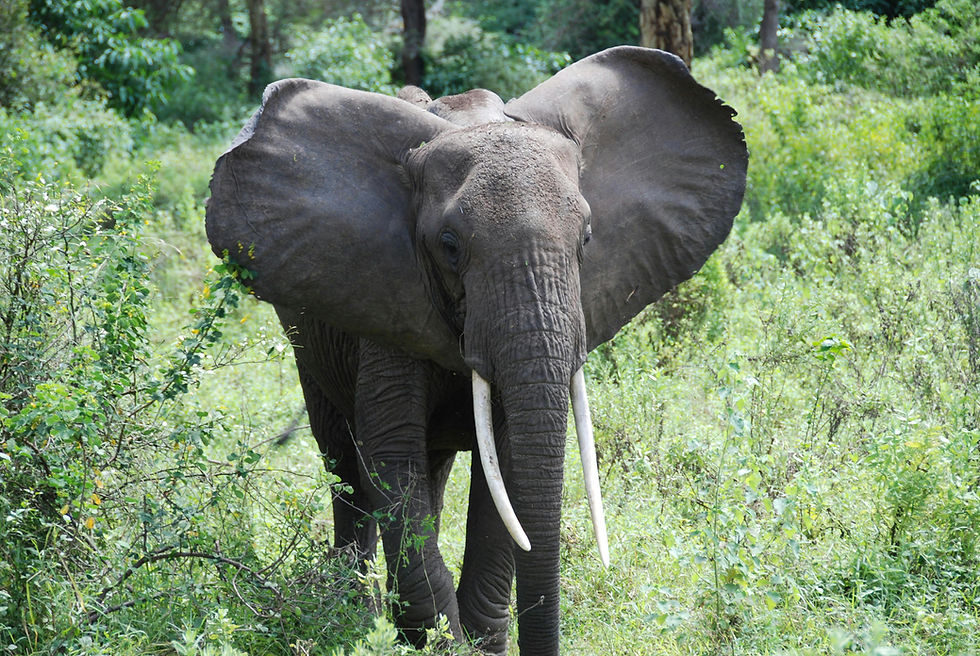
African Forest Elephant
Restoring them within protected areas in Central Africa could increase carbon storage by 13 million tonnes of CO₂ per year.
African forest elephants are often called “forest gardeners” in recognition of their irreplaceable role as seed dispersers in tropical forests. But scientists have found that their importance is far greater, as they also shape the very structure of the forest, and help increase the amount of carbon stored in the forests they inhabit. [1]
This influence is driven by their daily movement and feeding behaviour. As they move through tropical forests, elephants disperse the seeds of large, dense-wooded trees - sometimes also as the sole disperser of trees with large or hard-to-penetrate seeds. [2]
They also feed on and trample over smaller trees and plants, thinning the forest understory. This creates space, and reduces competition for light, air and water, allowing denser, more carbon-rich trees to survive. These trees, as they grow, are able to store more carbon than others. [3] At typical population densities, this increases aboveground biomass by 26–60 tonnes per hectare. Scientists estimate that the extinction of forest elephants would result in a 7% decrease in aboveground biomass across central African rainforests. [4]
Restoring elephants within protected areas could lead to measurable increases in annual CO₂ storage due to their behaviour and feeding habits. For example, in parts of Central Africa, restoring forest elephants within protected areas could increase carbon storage by an estimated 13 million tonnes of CO₂ each year. [3]
So when elephants disappear, the forest does not simply lose elephants. It can also lose part of its ability to maintain a more carbon-rich structure.
African Forest Elephant
Restoring them within protected areas in Central Africa could increase carbon storage by 13 million tonnes of CO₂ per year.
African forest elephants are often called “forest gardeners” in recognition of their irreplaceable role as seed dispersers in tropical forests. But scientists have found that their importance is far greater, as they also shape the very structure of the forest, and help increase the amount of carbon stored in the forests they inhabit. [1]
This influence is driven by their daily movement and feeding behaviour. As they move through tropical forests, elephants disperse the seeds of large, dense-wooded trees - sometimes also as the sole disperser of trees with large or hard-to-penetrate seeds. [2]
They also feed on and trample over smaller trees and plants, thinning the forest understory. This creates space, and reduces competition for light, air and water, allowing denser, more carbon-rich trees to survive. These trees, as they grow, are able to store more carbon than others. [3] At typical population densities, this increases aboveground biomass by 26–60 tonnes per hectare. Scientists estimate that the extinction of forest elephants would result in a 7% decrease in aboveground biomass across central African rainforests. [4]
Restoring elephants within protected areas could lead to measurable increases in annual CO₂ storage due to their behaviour and feeding habits. For example, in parts of Central Africa, restoring forest elephants within protected areas could increase carbon storage by an estimated 13 million tonnes of CO₂ each year. [3]
So when elephants disappear, the forest does not simply lose elephants. It can also lose part of its ability to maintain a more carbon-rich structure.